
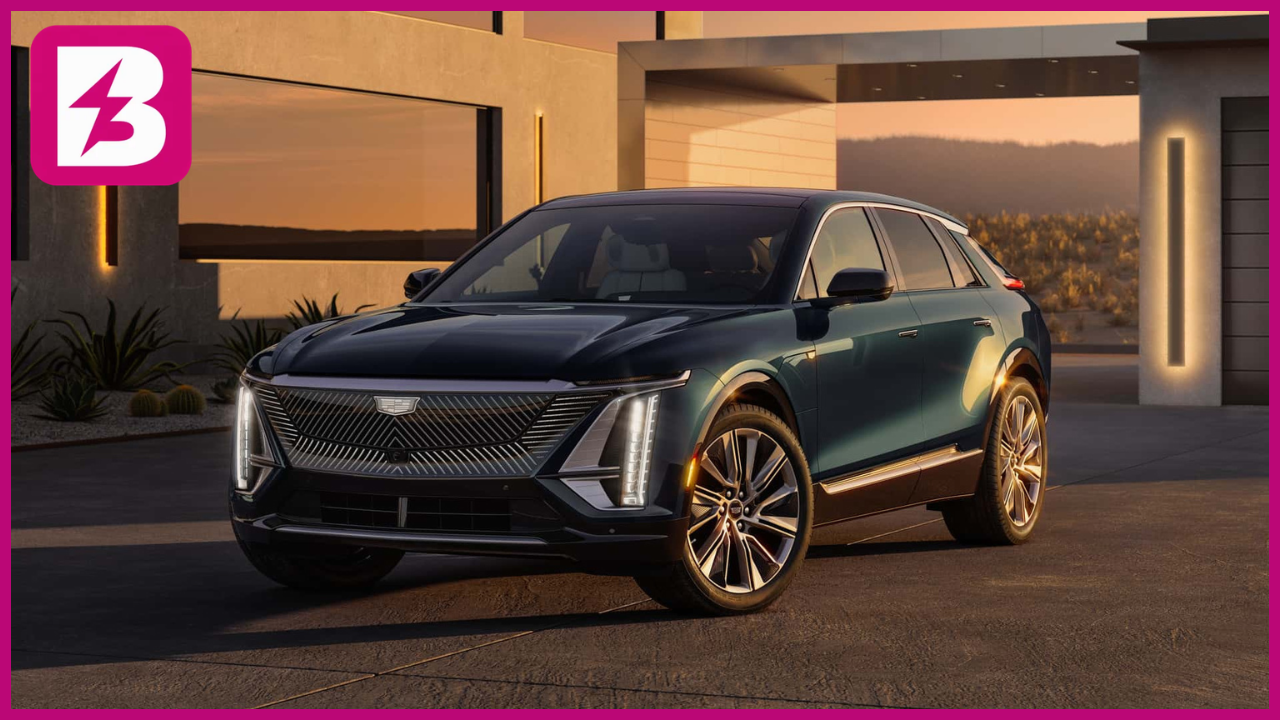
Do the Driving Modes in Cadillac LYRIQ Offer Different Ranges or Battery Usages?
Do the driving modes in Cadillac LYRIQ offer different ranges or battery usages? They can change how much energy you use on a journey, mainly through the way the car responds to your right foot. Cadillac publishes range estimates by vehicle configuration, with no separate mileage figure for each driving mode.
If you’re deciding between Tour and Sport before a long drive, start with what you want the accelerator to do. Then look at how efficiently you cover the miles. The two can be related, but a livelier pedal doesn’t automatically mean an extra charging stop.
Range, battery charge and efficiency answer different questions
Battery charge is how much energy you have left, shown as a percentage. Estimated range is a forecast of how far that energy might take you. Trip efficiency tells you how much distance you actually covered for the energy you used. For comparing driving modes, the third reading is the most useful.
Think of a 30-mile journey. At an average of 3 miles per kilowatt-hour (mi/kWh), it would take 10 kWh. At 2.5 mi/kWh, the same journey would take 12 kWh. Those figures are an illustration, not LYRIQ test results. They show why two drivers can leave with the same charge, cover the same distance and arrive with different amounts of energy left.
What changes in each Cadillac LYRIQ driving mode?
Cadillac describes four settings for the standard LYRIQ in its US model guide. Equipment can vary, so check the owner’s manual for your version, particularly if you drive the performance-focused LYRIQ-V.
| Mode | What changes | What it means for your journey |
|---|---|---|
| Tour | Smooth responses tuned for everyday driving | A useful starting point for measuring your usual efficiency. |
| Sport | More immediate torque response and a different steering feel | Brisk acceleration is easier to call on. How often you use it matters. |
| Snow/Ice | Gentler power delivery helps limit wheelspin on slippery surfaces | Choose it for grip. A cold, snowy trip is a poor comparison with a dry one. |
| My Mode | You can personalise settings such as accelerator response, steering and braking feel | If you like firmer steering, you can pair it with a gentler accelerator setting. |
Does Sport use more battery on a motorway?
Picture two trips along the same flat motorway. On both, you settle at the same speed, carry the same passengers and use the same cabin temperature. You may notice Sport’s sharper response on the slip road. Once you’re cruising, the car still has to overcome much the same rolling resistance and air resistance in either mode.
Now imagine using every gap in traffic to accelerate, then slowing down behind the next car. That changes the energy bill. Regenerative braking can recover some energy as you slow, but repeatedly building up speed costs energy. If your goal is to reach a distant charger with a comfortable margin, a steady, moderate cruising speed is a more useful adjustment than switching modes while keeping the same pace.
Why a winter range drop is hard to pin on Snow/Ice
A frosty morning changes several things at once. You may select Snow/Ice, turn up the cabin heat and spend longer covering your usual route. The energy used to warm the interior still comes out of the trip budget, even while you’re waiting at a junction.
If you charge at home, try warming the cabin while the LYRIQ is plugged in. Cadillac says plugged-in preconditioning can draw energy from the charger. That leaves more of the battery’s stored energy available when you set off, while letting you choose the driving mode that suits the road.
How to compare Tour and Sport on your commute
- Pick a familiar round trip. Start and finish in the same place so one drive doesn’t gain an advantage from a long downhill finish.
- Choose comparable days. Use similar starting charge levels, cabin settings and loads. Compare dry days with dry days, and note unusual traffic or wind.
- Record trip efficiency. Reset the trip reading before setting off, if available, and record the average when parked. Higher mi/kWh means more distance per unit of energy. If your display uses kWh/100 km, lower is better.
- Repeat in each mode. Alternate Tour and Sport over several runs at your normal pace. If results overlap, your route hasn’t shown a consistent advantage for either setting. One unusually clear run can make a favourite mode look better than it is.
Frequently asked questions
Is there an Eco mode on the Cadillac LYRIQ?
Cadillac lists Tour, Sport, Snow/Ice and My Mode for the standard model discussed here. Tour is the everyday setting and a sensible place to start if you like smooth acceleration.
Does one-pedal driving give the LYRIQ more range?
It can help you recover energy when you need to slow down. The High setting increases deceleration when you ease off the accelerator. It doesn’t promise extra miles. Cadillac advises against one-pedal driving on slippery roads and says to use the brake pedal when you need to stop immediately.
Can I calculate a Sport mode penalty for a road trip?
Cadillac gives no fixed percentage to subtract for Sport. For trip planning, use your recent efficiency on similar roads and check charging options along the route. A town-centre average is a poor guide to a cold motorway journey.
Does switching to Tour increase my battery percentage?
Selecting Tour adds no energy to the battery. If you drive more efficiently afterwards, the charge you already have can take you farther. That’s also why the estimated miles and the charge percentage answer different questions.
Conclusion
Do the driving modes in Cadillac LYRIQ offer different ranges or battery usages? Real-world energy use can differ, but Cadillac assigns no fixed range to each mode. Choose Tour for a smooth commute, Sport for a quicker response and Snow/Ice when traction calls for it. On your next two comparable dry drives, record your trip efficiency in Tour and Sport. That gives you a starting point for choosing the setting you enjoy on the roads you actually drive.
Read more : Buzzstories.co.uk